


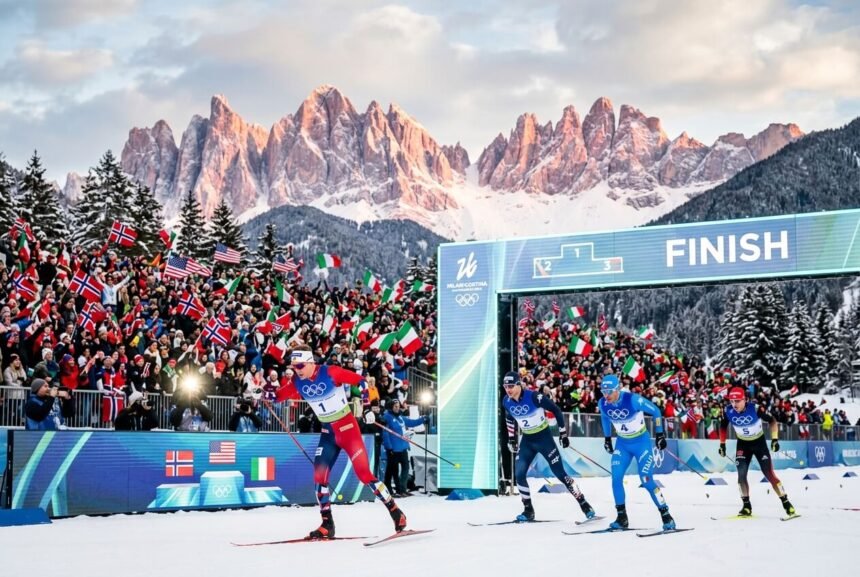
Every four years, the Winter Olympics offer a snapshot of which nations have invested most effectively in winter sports — and the Milan-Cortina 2026 Winter Olympics were no exception. Held across Milan and Cortina d’Ampezzo, Italy, from February 6 to 22, the Games delivered a familiar name at the top of the medal table, alongside a historic showing from the host nation.
With 346 medals awarded across 29 medal-winning countries, the Games produced plenty of storylines beyond just the final standings — including host-nation heroics, dramatic comebacks, and a genuine changing of the guard in several disciplines.
Norway Extends Its Winter Dominance
Norway once again finished at the top of the medal table, winning 18 gold medals and 41 medals overall — the most of any nation at the Games. This continued a remarkable run for the Scandinavian nation, which has now topped the Winter Olympics medal table for three consecutive Games, following victories at PyeongChang 2018 and Beijing 2022.
Norway’s dominance was built on strength across multiple disciplines, particularly cross-country skiing and biathlon, areas where the country has invested heavily in athlete development for decades.
Italy’s Historic Home Games
As hosts, Italy delivered arguably their best-ever Winter Olympic performance, finishing fourth in the overall medal table with 10 gold, 6 silver, and 14 bronze medals for a total of 30 medals.
A Story of Resilience
One of the most memorable moments of the Games came from Federica Brignone, who won gold in the women’s super-G just ten months after a serious injury that had threatened to end her Olympic dream — and potentially her career. Her victory, watched by Italy’s President Sergio Mattarella, became one of the defining images of the entire Games.
Italy also enjoyed strong showings in speed skating and biathlon, with athletes like Francesca Lollobrigida and the country’s biathlon relay team contributing multiple medals throughout the two-and-a-half-week competition.
The Full Final Medal Table
Here’s how the top of the table looked once the Games concluded:
| Rank | Country | Gold | Silver | Bronze | Total |
|---|---|---|---|---|---|
| 1 | Norway | 18 | 12 | 11 | 41 |
| 2 | United States | 12 | 12 | 9 | 33 |
| 3 | Netherlands | 10 | 7 | 3 | 20 |
| 4 | Italy (host) | 10 | 6 | 14 | 30 |
| 5 | Germany | 8 | 10 | 8 | 26 |
| 6 | France | 8 | 9 | 6 | 23 |
| 7 | Sweden | 8 | 6 | 4 | 18 |
| 8 | Switzerland | 6 | 9 | 8 | 23 |
| 9 | Austria | 5 | 8 | 5 | 18 |
| 10 | Japan | 5 | 7 | 12 | 24 |
Strong Showings from the United States and Netherlands
The United States finished second overall with 12 gold and 33 total medals, one of its strongest Winter Olympics showings in years, driven by performances across figure skating, speed skating, and freestyle skiing disciplines. Highlights included silver-medal performances in speed skating and ski big air, along with a bronze-medal finish for figure skater Alysa Liu in the women’s short program.
The Netherlands also had a standout Games, finishing third overall with 10 gold medals, continuing the country’s traditional strength in speed skating events.
Key Facts / Quick Summary
- Host cities: Milan and Cortina d’Ampezzo, Italy
- Dates: February 6–22, 2026
- Medal-winning nations: 29 countries won at least one medal
- Total medals awarded: 346
- Top nation: Norway (18 gold, 41 total medals) — their third consecutive Winter Olympics medal-table win
- Host nation performance: Italy finished 4th overall with 30 medals, their best-ever Winter Olympics showing
Expert-Style Analysis
Norway’s continued dominance at the top of the Winter Olympics medal table isn’t a coincidence — it reflects sustained, long-term investment in winter sports infrastructure and athlete pipelines, particularly in cross-country and biathlon disciplines where the country has few genuine rivals in terms of overall depth.
Italy’s performance as hosts, however, is arguably the more compelling storyline of these Games. Finishing fourth overall, with their highest-ever medal total, suggests the “home advantage” effect wasn’t just symbolic — it translated into genuine competitive results, particularly in Alpine skiing and speed skating events held on home snow and ice.
The strong showings from the United States and Netherlands also point to a Winter Olympics landscape that remains genuinely competitive at the top, rather than a two-nation race. With four countries — Norway, the US, Netherlands, and Italy — combining for well over 100 medals between them, the depth of competition at Milan-Cortina 2026 was arguably as significant a storyline as who finished on top.
Frequently Asked Questions
Q1: Which country topped the medal table at the Milan-Cortina 2026 Winter Olympics?
Norway finished first with 18 gold medals and 41 total medals.
Q2: How did host nation Italy perform at the 2026 Winter Olympics?
Italy finished fourth overall with 10 gold, 6 silver, and 14 bronze medals — their best-ever Winter Olympics performance.
Q3: When were the Milan-Cortina 2026 Winter Olympics held?
The Games ran from February 6 to 22, 2026, across Milan and Cortina d’Ampezzo, Italy.
Q4: How many countries won medals at the 2026 Winter Olympics?
A total of 29 countries won at least one medal.
Q5: How many total medals were awarded at Milan-Cortina 2026?
A total of 346 medals were awarded across all disciplines.
Q6: Has Norway topped the Winter Olympics medal table before?
Yes, this marked Norway’s third consecutive Winter Olympics at the top of the medal table, following PyeongChang 2018 and Beijing 2022.
The Milan-Cortina 2026 Winter Olympics delivered exactly what fans hope for from a home Games: fierce competition at the top of the medal table, a historic performance from the host nation, and moments of individual triumph that will be remembered long after the closing ceremony. Norway’s continued dominance confirms their status as the era’s leading winter sports nation, but Italy’s record-breaking showing as hosts ensures Milan-Cortina 2026 will be remembered as far more than just a backdrop for someone else’s success.