

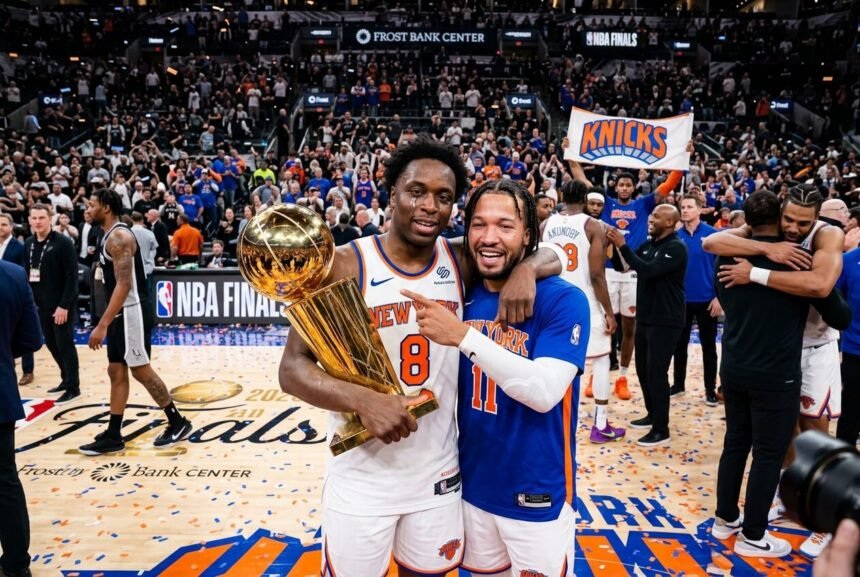
Fifty-two years is a long time to wait for anything, let alone a championship in the biggest market in American sports. But in June 2026, the Knicks NBA championship 2026 finally arrived, as New York beat the San Antonio Spurs to win their first title since 1973 — a moment defined by one of the most improbable comebacks in NBA Finals history.
For a franchise defined for decades by near-misses and rebuilding cycles, this title represents a genuine changing of the guard in the Eastern Conference and the NBA at large.
The Comeback That Changed Everything
The turning point of the entire series came in Game 4 at Madison Square Garden, when the Knicks erased a 29-point deficit to beat the Spurs 107-106 — the biggest comeback in NBA Finals history. The game was sealed by forward OG Anunoby, who rose to tip in a missed three-pointer from Jalen Brunson with just 1.2 seconds remaining.
That single play pushed the Knicks to a 3-1 series lead and set up their eventual championship-clinching win at San Antonio’s Frost Bank Center.
A Quietly Dominant Postseason
Anunoby’s game-winner became the signature moment of New York’s title run, but his overall production throughout the series was equally significant. Across the Finals, he averaged 23.8 points per game, shooting 58% from the field and 55.6% from three-point range — numbers that put him firmly in the conversation for Finals MVP.
His performance in Game 4 alone — 10-for-15 shooting, including 7-for-9 from beyond the arc — underlined just how central he had become to New York’s championship formula, a far cry from his original reputation as primarily a defensive specialist when the Knicks acquired him from Toronto during the 2023-24 season.
The Road Through the Playoffs
New York’s path to the title ran through some of the toughest teams in the Eastern Conference. They dispatched the Atlanta Hawks in six games in the conference quarterfinals before sweeping the Philadelphia 76ers 4-0 in the semifinals, and then completing a dominant 4-0 sweep of the Cleveland Cavaliers in the Eastern Conference Finals.
That set up a Finals matchup against a young, talented San Antonio Spurs side that had home-court advantage and, for most of Game 4, appeared to be cruising toward regaining control of the series before New York’s historic rally changed the entire complexion of the championship.
Why This Title Means So Much
The Knicks’ previous championship came in 1973 — a gap of 52 years that included multiple deep playoff runs, notable Finals appearances in the 1990s, and long stretches of rebuilding that tested the patience of one of the league’s most passionate fanbases.
The Trade That Made It Possible
Much of the credit for constructing this roster goes back to a controversial decision made by team president Leon Rose, who traded away two of the franchise’s promising young players, RJ Barrett and Immanuel Quickley, to acquire Anunoby from Toronto during the 2023-24 season. At the time, the deal was questioned by many observers who saw Barrett and Quickley as rare homegrown successes for a franchise that had struggled to develop talent. New York’s championship run has largely settled that debate.
Key Facts / Quick Summary
- Champion: New York Knicks, first title since 1973
- Finals opponent: San Antonio Spurs
- Defining moment: OG Anunoby’s Game 4 tip-in completing a 29-point comeback, the largest in NBA Finals history
- Anunoby’s Finals averages: 23.8 points per game, 58% field goal shooting, 55.6% from three-point range
- Path to the Finals: Beat Atlanta Hawks (4-2), swept Philadelphia 76ers (4-0), swept Cleveland Cavaliers (4-0)
Expert-Style Analysis
Championship teams are often defined by a single signature moment, and for these Knicks, that moment will always be Anunoby’s tip-in in Game 4. But reducing his title run to one shot undersells just how central he became to New York’s success throughout the postseason — a player once known primarily for his defensive versatility evolved into a genuine two-way superstar on the league’s biggest stage.
The decision to trade Barrett and Quickley for Anunoby looked like a significant gamble at the time, particularly given how promising both young players appeared. In hindsight, it’s the kind of decision that championship-caliber front offices are ultimately judged on — prioritizing a proven two-way contributor over draft-pick potential, and having that bet pay off in the most decisive way possible.
For a franchise that has spent decades being defined by frustration and unmet expectations, ending a 52-year title drought changes the entire trajectory of the Knicks as an organization — both in terms of how they’re perceived around the league and how they’ll be able to recruit and retain talent going forward.
Frequently Asked Questions
Q1: When was the last time the Knicks won an NBA championship before 2026?
Their previous title came in 1973, making this a 52-year gap between championships.
Q2: Who did the Knicks beat in the 2026 NBA Finals?
They defeated the San Antonio Spurs to win the championship.
Q3: What was the biggest moment of the Knicks’ championship run?
OG Anunoby’s Game 4 tip-in, completing a 29-point comeback — the largest in NBA Finals history — is considered the defining moment of the series.
Q4: How did OG Anunoby perform in the 2026 NBA Finals?
He averaged 23.8 points per game while shooting 58% from the field and 55.6% from three-point range across the series.
Q5: How did the Knicks get to the NBA Finals in 2026?
They beat the Atlanta Hawks 4-2 in the conference quarterfinals, swept the Philadelphia 76ers 4-0 in the semifinals, and swept the Cleveland Cavaliers 4-0 in the Eastern Conference Finals.
Q6: Why was the trade for OG Anunoby considered controversial at the time?
The Knicks gave up RJ Barrett and Immanuel Quickley, two promising young players, to acquire him from Toronto during the 2023-24 season.
The Knicks NBA championship 2026 will be remembered as one of the great redemption stories in modern NBA history — a franchise that waited 52 years for a title, sealed in dramatic fashion by the biggest comeback in Finals history. OG Anunoby’s transformation from defensive specialist to Finals hero, and the front office’s willingness to make a bold trade to acquire him, together tell the story of how New York finally ended its long championship drought.