

Life of an F1 Driver: Training, Skills and the Road to the Grid
Only twenty drivers hold a Formula 1 race seat at any given time, making it one of the most exclusive jobs in professional sport. Getting there — and staying there — requires a rare mix of physical conditioning, mental resilience, technical understanding, and commercial appeal that goes far beyond simply being fast behind the wheel.
The Path to Formula 1
Almost every current Formula 1 driver followed a similar structural path through the junior motorsport ladder: karting as a child, progressing through Formula 4, Formula 3, and Formula 2, each step bringing faster cars, bigger fields, and more complex racecraft. This pathway is now formalised through the FIA’s Super Licence points system, which requires drivers to accumulate a minimum number of points from junior championship results before they are eligible to compete in Formula 1.
Karting remains the foundation for nearly all professional drivers, teaching the core skills of car control, racecraft, and racing instinct at a young age, often before a driver is even a teenager. From there, junior single-seater categories introduce increasingly sophisticated aerodynamics and higher cornering speeds, closely mirroring the technical challenges drivers will eventually face in Formula 1 itself.
Physical Demands of Driving an F1 Car
Formula 1 drivers experience forces that would be genuinely dangerous for an untrained body. Cornering can subject drivers to lateral G-forces exceeding 5G, meaning their head and neck must resist a force multiple times their own body weight, repeated dozens of times per lap over race distances that can last close to two hours. Cockpit temperatures regularly exceed 50 degrees Celsius, and drivers can lose several kilograms in body weight through sweat during a single race.
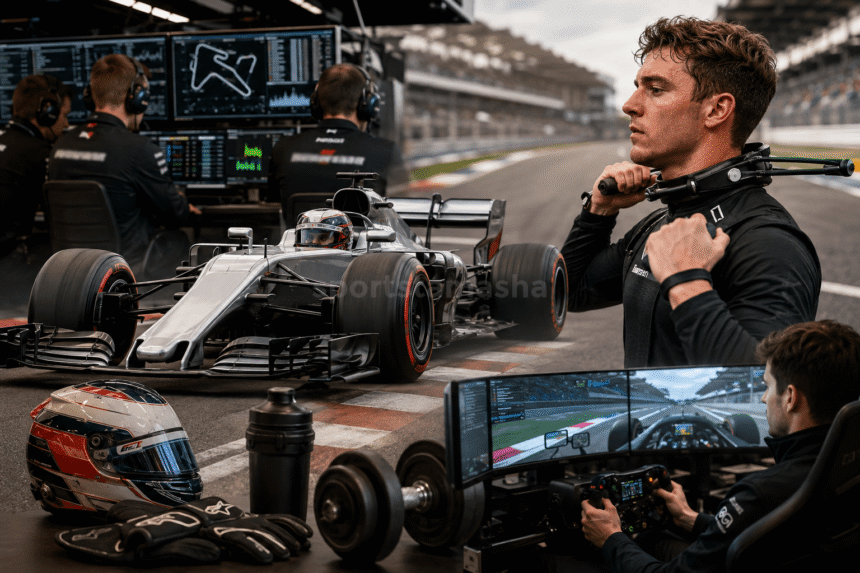
To cope with these demands, drivers follow rigorous training regimes built around cardiovascular fitness, neck-strengthening exercises, and reaction-time training. Neck strength is particularly important, as it directly determines a driver’s ability to keep their head stable under sustained cornering loads without fatiguing over race distance.
Mental Skills That Matter as Much as Speed
Raw speed alone rarely defines a successful Formula 1 career. Drivers must process enormous amounts of information in real time — tyre degradation, fuel strategy updates relayed by race engineers, gaps to rivals, and changing weather — while maintaining the split-second reflexes needed to react to incidents at speeds exceeding 300 kilometres per hour. This combination of sustained concentration and instant decision-making is one of the reasons team principals and talent scouts place such heavy emphasis on a young driver’s racecraft and composure under pressure, not just their raw lap times.
Communication with the engineering team is another underrated skill. Drivers who can clearly and accurately describe how a car is behaving — understeer, oversteer, brake balance issues — give their engineers the information needed to make effective setup changes, directly influencing performance across a race weekend.
The Role of Simulators and Technology
Modern Formula 1 drivers spend significant time in advanced driving simulators, both to prepare for upcoming circuits and to test car setup changes without the cost of on-track running, which is heavily restricted by testing regulations. Simulators have become essential preparation tools, particularly for new circuits or configurations a driver has never physically driven, allowing them to build muscle memory for braking points and racing lines before a wheel ever touches the actual track surface.
Building a Commercial Profile
Beyond performance on track, modern Formula 1 drivers are also expected to build a personal brand. Sponsorship deals, media appearances, and social media presence have become increasingly important, particularly as the sport’s audience has grown younger and more digitally engaged. Drivers who successfully build a strong public profile often attract personal sponsorship deals independent of their team contracts, covering everything from fashion and lifestyle brands to technology and financial services partners.
This commercial dimension has become a genuine factor in a driver’s career longevity — teams value drivers who can help attract and retain sponsors, alongside their on-track performance, particularly at smaller or mid-grid teams where budget considerations weigh heavily on driver selection decisions.
Career Longevity and Retirement
Formula 1 careers can vary enormously in length. Some drivers compete into their forties, relying on experience and racecraft to remain competitive, while others find their careers cut short after only a season or two if results don’t meet team or sponsor expectations. Team seat changes are common at the end of each season, driven by performance, budget, and the emergence of new junior talent pushing for opportunities.
Many former drivers transition into media punditry, team management, or driver coaching roles after their competitive careers end, staying involved in the sport in a different capacity while passing on the knowledge accumulated over years at the sport’s highest level.
Frequently Asked Questions
What is a Super Licence, and why do drivers need one? A Super Licence is the FIA-issued licence required to compete in Formula 1, granted only to drivers who accumulate sufficient points through results in recognised junior racing championships.
How fit do Formula 1 drivers need to be? Extremely fit — drivers require strong cardiovascular endurance, exceptional neck and core strength, and fast reaction times to cope with the physical demands of racing at high speed under sustained G-forces.
Do Formula 1 drivers design their own car setups? No, but they work closely with engineers, providing detailed feedback that shapes setup decisions specific to their driving style and the demands of each circuit.
Why do sponsorship deals matter so much for F1 drivers? Sponsorship income supplements team salaries and, particularly for drivers at smaller teams, can be a deciding factor in whether a driver retains their seat for the following season.
Behind every overtake and podium celebration lies years of physical conditioning, technical education, and career navigation — a reminder that being an F1 driver is as much about relentless preparation as it is about raw talent.
Handling Media Scrutiny and Public Pressure
Formula 1 drivers operate under intense media scrutiny, with every race weekend involving multiple press conferences, television interviews, and increasingly, direct engagement with fans through social media platforms. Learning to manage this public-facing dimension of the role, while maintaining focus on race weekend performance, is a skill many young drivers must develop alongside their on-track abilities. Experienced media training has become a standard part of driver development programmes at many teams, helping young talent navigate high-pressure press conferences and potentially controversial on-track incidents without damaging their personal or team reputation.