


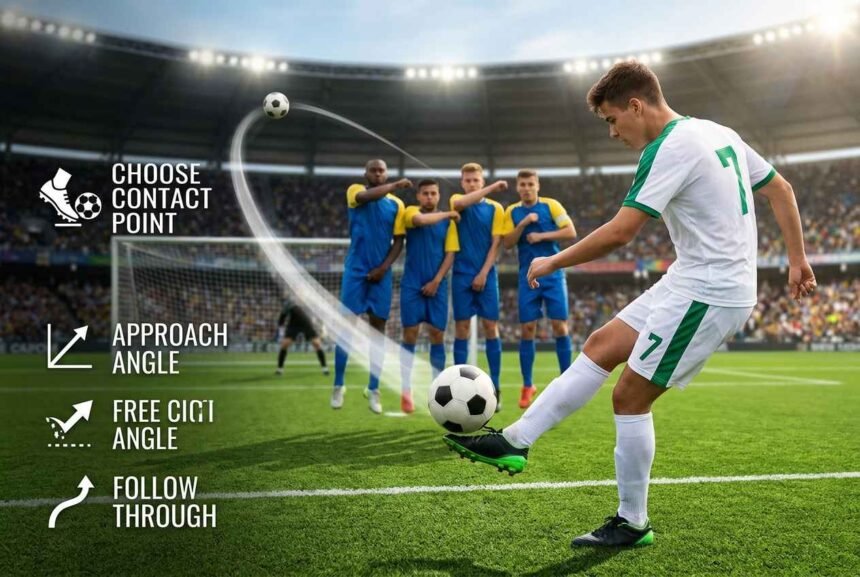
Few sights in football are as thrilling as a ball bending impossibly around a wall of defenders and dropping into the top corner. Learning how to curve a football is one of the most valuable skills a player can add to their game. It turns straight shots into unstoppable weapons and free kicks into genuine goal-scoring opportunities.
This guide breaks down everything you need to know about curving a football — the science behind it, the exact foot technique, step-by-step drills, common mistakes, and how to practice like the professionals. Whether you are a beginner trying your first curved pass or an experienced player refining your free-kick technique, this article will help you bend the ball with confidence and consistency.
By the end of this guide, you will understand exactly how to curve a football using both the inside and outside of your foot, how to control the amount of curve, and how to build a practice routine that turns this skill into muscle memory.
Why Learning to Curve a Football Matters
A player who can curve the ball has more attacking options than one who can only strike it straight. Curving opens up passing lanes that a defender cannot block, creates shooting angles that goalkeepers struggle to read, and makes set pieces far more dangerous.
Here is why this skill is worth mastering:
- It allows you to bend passes around defenders instead of through them.
- It creates unpredictable shot trajectories that are harder for goalkeepers to save.
- It makes free kicks and corners genuine scoring threats.
- It improves your overall ball-striking technique and foot control.
- It separates average players from technically gifted ones.
Coaches at every level value players who can manipulate the ball’s flight path, and this is exactly what curving teaches your body to do.
The Science Behind Curving a Football: Understanding the Magnus Effect
Before learning the technique, it helps to understand why a football curves in the first place. The answer lies in physics, specifically something called the Magnus effect.
When you strike a ball off-center, you make it spin. That spin creates a difference in air pressure on either side of the ball. The side spinning in the same direction as the airflow experiences lower pressure, while the opposite side experiences higher pressure. This pressure difference pushes the ball sideways, creating the curved flight path you see in a bending free kick or a swerving cross.
In simple terms:
- More spin generally means more curve.
- The direction of spin determines which way the ball bends.
- Ball contact point is the single biggest factor controlling both spin and curve.
Understanding this principle changes how you think about striking the ball. Curving is not about kicking harder — it is about kicking smarter, with precise contact on a specific part of the ball.
Types of Curve in Football
There are several distinct types of curve you can produce, and each serves a different purpose on the pitch.
1. Inswinging Curve
An inswinger curves toward the goal or toward the body of a teammate. Right-footed players typically produce an inswinger when striking with the inside of the foot on a ball delivered from the right side, curving it left, and vice versa for left-footed players. This is the classic technique used for corners that swing in toward the six-yard box.
2. Outswinging Curve
An outswinger curves away from the goal or away from teammates, moving in the opposite direction of an inswinger. This is often used to move the ball away from a crowded penalty area or to bend a shot away from a goalkeeper’s reach.
3. Knuckleball (Zero-Spin) Shot
Unlike the two techniques above, a knuckleball shot is struck with minimal spin, causing unpredictable, late movement in the air. This technique, made famous by players like Cristiano Ronaldo, relies on precise, flat contact through the center of the ball rather than an off-center strike.
Knowing which type of curve you want to produce before you strike the ball is the first step toward mastering the technique.
How to Curve a Football: Step-by-Step Technique
Now let’s break down the actual mechanics of curving the ball. This is the core technique you need to practice repeatedly until it becomes instinctive.
Step 1: Choose Your Contact Point
The contact point is the most important factor in curving a football. To bend the ball:
- Strike the lower outer half of the ball with the inside of your foot to curve it away from your kicking foot’s side.
- Strike the lower inner half of the ball with the outside of your foot to curve it in the opposite direction.
Never strike the center of the ball if your goal is to curve it — center contact produces a straight, non-curving shot.
Step 2: Set Your Approach Angle
Your run-up should be angled, not straight toward the ball. A curved or diagonal approach — typically 30 to 45 degrees to the ball — allows your foot to wrap around the ball naturally during contact, generating the spin needed for curve.
Step 3: Plant Your Standing Foot Correctly
Your standing (non-kicking) foot should be placed slightly to the side of the ball, roughly 6 to 10 inches away, with toes pointing toward your intended target. This foot acts as your balance point and directly affects the angle of your kicking leg swing.
Step 4: Strike With the Right Part of the Foot
- Inside-of-the-foot curve: Use the area near your big toe and arch. Lock your ankle firmly and strike through the lower-outer quadrant of the ball.
- Outside-of-the-foot curve: Use the outside edge of your foot, near your smallest toes. This produces a sharper, often more disguised curve.
Step 5: Follow Through Across Your Body
The follow-through is what finalizes the spin. After contact, allow your kicking leg to swing across your standing leg rather than straight forward. This wrap-around motion is what generates the rotation needed for the ball to curve in flight.
Step 6: Control Power and Spin Together
Beginners often make the mistake of striking the ball as hard as possible. Curving requires a balance between pace and spin. Too much power with too little spin produces a shot that barely bends; too much spin with too little power produces a shot that curves but lacks the pace to trouble a goalkeeper.
Curving the Ball With the Inside of the Foot
This is the most common and beginner-friendly method for curving a football, made globally famous by free-kick specialists.
- Approach the ball at an angle, not head-on.
- Plant your standing foot beside the ball, pointing toward your target.
- Strike the lower-outer part of the ball using the inside of your foot, near the arch.
- Lock your ankle at the moment of contact for control.
- Follow through across your body, letting your kicking leg swing toward the opposite side.
This technique is ideal for free kicks, corners, and long-range passes where you want the ball to bend into a specific area, such as around a defensive wall and into the top corner of the goal.
Curving the Ball With the Outside of the Foot
The outside-of-the-foot curve is a more advanced technique that produces a faster, more disguised bend. It is especially effective because it does not require as long a backswing, allowing you to disguise your intentions from defenders and goalkeepers.
- Approach the ball more directly, almost straight on.
- Strike the ball using the outside edge of your foot, near the little toe.
- Contact the lower-inner portion of the ball to generate spin in the opposite direction of the inside-foot technique.
- Keep your ankle relaxed but stable through contact.
- Follow through with a shorter, whipping motion rather than a full body wrap-around.
Many elite wingers and attacking midfielders use this technique for whipped crosses and surprise shots on goal.
How to Practice Curving a Football: Drills That Work
Technique alone is not enough — consistent practice is what turns curving into a reliable weapon. Below are structured drills to build this skill from the ground up.
Drill 1: Stationary Ball Curve Practice
Set up a stationary ball about 20 yards from a wall or goal.
- Focus only on contact point for the first 20 repetitions — do not worry about power.
- Gradually increase power once your curve direction is consistent.
- Alternate between inside-foot and outside-foot strikes.
Drill 2: Target Curve Drill
Place two cones a few feet apart to represent a “wall,” and a target beyond them.
- Try to curve the ball around the cones and into the target.
- This mimics real free-kick scenarios and builds decision-making alongside technique.
Drill 3: Moving Ball Curve Drill
Once comfortable with a stationary ball, practice curving a rolling ball passed to you by a partner or rebounded off a wall.
- This builds the ability to curve the ball under match-realistic conditions.
- Focus on quick setup and a consistent strike, since you will have less time to adjust your approach.
Drill 4: Both-Direction Curve Drill
Alternate striking curves in both directions (inswing and outswing) in the same session.
- This prevents your body from favoring only one type of curve.
- It also improves overall ball control and footwork.
Drill 5: Free-Kick Wall Simulation
Set up a row of cones or mannequins as a wall and practice bending shots over and around them into the goal.
- Vary the distance and angle to simulate different match situations.
- Track your success rate to measure improvement over time.
Recommended Practice Schedule:
| Week | Focus | Repetitions |
|---|---|---|
| Week 1–2 | Stationary contact point drills | 40–50 per session |
| Week 3–4 | Target curve drills | 30–40 per session |
| Week 5–6 | Moving ball drills | 30 per session |
| Week 7–8 | Free-kick wall simulation | 20–30 per session |
Consistency matters more than intensity. Short, focused daily sessions build muscle memory faster than occasional long sessions.
Common Mistakes When Trying to Curve a Football
Even experienced players fall into these traps. Avoiding them will accelerate your progress significantly.
- Striking the center of the ball — this produces a straight shot with no curve, regardless of technique.
- Approaching the ball head-on — a straight-line approach limits the wrap-around motion needed for spin.
- Locking the whole leg instead of the ankle — tension in the wrong muscles reduces control and spin quality.
- Prioritizing power over contact accuracy — a hard, poorly placed strike will not curve effectively.
- Rushing the follow-through — cutting the swing short reduces the spin generated on the ball.
- Ignoring the standing foot’s position — an incorrectly placed standing foot throws off your entire strike angle.
- Practicing only one direction of curve — this limits your versatility in real match situations.
Correcting even one or two of these mistakes can dramatically improve your ability to curve the ball consistently.
How Professional Footballers Curve the Ball
Studying professional technique can offer valuable insight, even though every player adapts the fundamentals to their own style.
- Free-kick specialists known for bending shots typically rely on a curved run-up and inside-foot contact to generate dramatic bend over defensive walls.
- Wingers famous for whipped, curling crosses often use the outside-of-the-foot technique to deliver the ball into dangerous areas quickly.
- Players known for knuckleball-style shots use minimal spin and a firm, flat strike through the ball’s center to create unpredictable movement rather than a smooth curve.
While every player has a unique style, the underlying mechanics — contact point, approach angle, and follow-through — remain consistent across all elite-level technique.
Equipment Considerations for Curving a Football
While technique is the most important factor, equipment can play a supporting role.
- Ball type: Match-quality balls with consistent panel construction curve more predictably than cheaper, uneven balls.
- Boot choice: Boots with a smooth, textured striking zone near the instep can improve grip and spin generation.
- Ball pressure: A properly inflated ball respond more predictably to spin than an over- or under-inflated one.
- Playing surface: Wind and turf conditions affect curve behavior, so practicing in varied conditions builds adaptability.
None of this equipment replaces technique, but the right gear can make your practice sessions more consistent and representative of match conditions.
How to Curve a Football for Free Kicks Specifically
Free kicks deserve special attention since this is where curving a football is most visible and most rewarded.
- Assess the wall and goalkeeper position before deciding which type of curve to use.
- Choose your technique — inside-foot for a classic bending shot over the wall, outside-foot for a quicker, more disguised strike.
- Pick your target zone, usually the top corners, since these are hardest for goalkeepers to reach even when they read the curve correctly.
- Commit fully to your approach and follow-through — hesitation reduces both power and spin.
- Practice from match-realistic distances, typically 18 to 25 yards, since curve behavior changes with distance.
Free-kick success comes from combining correct technique with confidence and repetition under realistic conditions.
Frequently Asked Questions About Curving a Football
What causes a football to curve in the air?
A football curves because of the Magnus effect. When the ball spins, it creates a pressure difference between its two sides, and this pressure difference pushes the ball in the direction of the curve.
Which part of the foot should I use to curve a football?
You can curve a football using either the inside of your foot (for a classic inward or outward bend) or the outside of your foot (for a quicker, sharper curve). Contact point matters more than which part of the foot you use.
Can beginners learn to curve a football quickly?
Yes. With focused practice on contact point and follow-through, most beginners can produce a noticeable curve within a few practice sessions, though consistency takes longer to develop.
Why does my curved shot lack power?
This usually happens when too much focus is placed on spin and not enough on a controlled, confident strike. Balancing spin generation with a committed follow-through solves this issue.
Is curving the ball more important for free kicks or open play?
Both. Free kicks showcase curving most dramatically, but curved passes and crosses in open play are equally valuable for creating scoring opportunities.
How long does it take to master curving a football?
With consistent practice — ideally several sessions per week — most players see solid improvement within 4 to 8 weeks, though true mastery is an ongoing process refined over years.
Learning how to curve a football is a skill that rewards patience, precision, and repetition. It is not about brute strength but about understanding contact point, approach angle, and follow-through — and then practicing these elements until they become second nature.
Start with the basics: focus on where your foot meets the ball, commit to your follow-through, and practice both inside-foot and outside-foot techniques. Use the drills outlined in this guide consistently, and track your progress over time.
Whether your goal is to score unstoppable free kicks or deliver pinpoint curling crosses, mastering this skill will make you a far more dangerous and versatile player on the pitch.